



A car chrome delete replaces the bright trim on a car with film instead of paint, usually in gloss black, satin black or a matte finish. On most cars that means window surrounds, mirror caps, the grille frame, badges and lower door trim. Expect a range of roughly 400 to 1,200 USD depending on how many parts come off the car, and expect it to last as long as the film under it, which is years rather than months. Done without removing the parts, it lifts at the corners within a season.
What is a chrome delete on a car?
It is not a product, it is a scope. You decide which bright pieces stop being bright. A full car chrome delete usually covers the window surrounds, the B-pillar covers, mirror caps, the grille surround, the badges front and rear, and the trim strip along the lower doors. A partial delete is often just the window surrounds, which is also where most of the visual change sits.
The film itself is cast vinyl, the same material family used for a full color change. We use it from 3M and from Avery, Orafol and Inozetek depending on the finish. Paint protection film is a different job and does not belong here: a delete is a color decision, not a protection one. If you are weighing the two, our comparison of PPF against a vinyl wrap sets them side by side.
Which parts can actually be wrapped?
Window surrounds, mirror caps, grille frames, badges, pillar covers and flat lower trim all take film well. They are either removable or have a clean edge the film can wrap behind, which is the whole game.
Some parts we will decline. Textured plastic grille mesh holds film on the face and releases it in every valley. Exhaust tips get too hot. Deep chrome window channels with a rubber lip that cannot be lifted leave the film with nowhere to terminate, so it sits as a butt joint and a car wash finds it in six months. Honest answer on those: leave them, or have them powder coated.
Why does a sprayed or dipped delete fail?
Because chrome is a release surface. It is smooth, hard and designed to shed water, which is the opposite of what a coating needs. Peelable rubber coatings stay on while nothing touches them and then tear at the first pressure washer. We have taken enough of it off to be blunt about it, which is why we wrote about why plasti dip does not hold on a whole car.
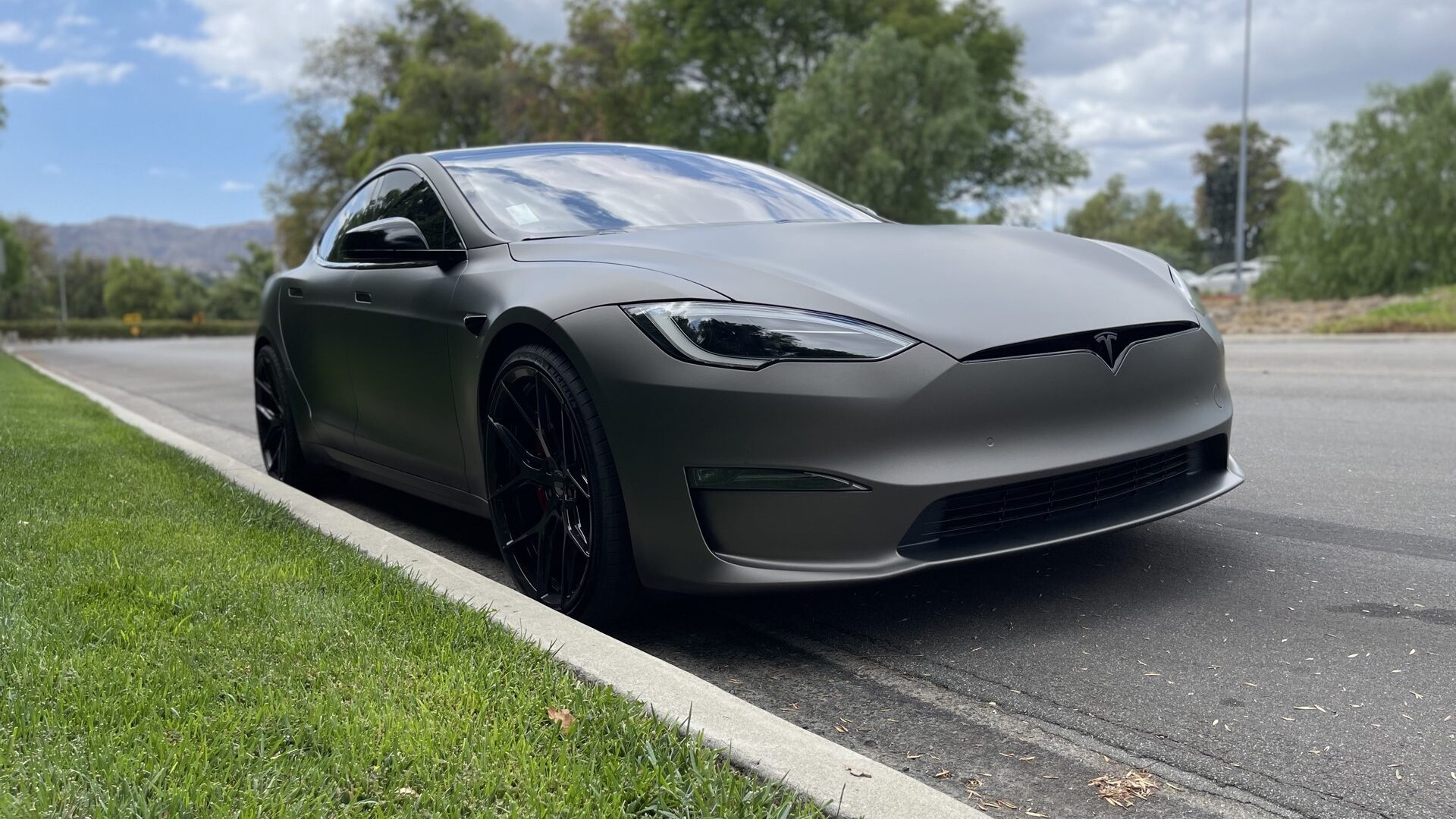
Film works on the same surface because it is pressure sensitive adhesive wrapped around an edge rather than a layer resting on a face. On the Tesla Model S Plaid we wrapped at Westlake Village, the body went to 3M 2080 M211 Matte Charcoal Metallic and the chrome delete, smoked taillights and ceramic tint were done in the same visit, so every trim edge was handled with the panels already in hand. That is why it reads as one car rather than a car with black tape on it.

How much does a car chrome delete cost?
As orientation ranges in the United States, not a price list: window surrounds alone sit around 300 to 600 USD, a full delete with mirrors, grille and badges around 600 to 1,200 USD, and more on cars where the trim is bonded rather than clipped. Removal and refitting of trim is most of the labor, so a car that gives its parts up easily costs less than a car that does not. European pricing in Weelde runs lower on labor and higher on film.
How long does a chrome delete last?
On vertical trim, five to seven years is normal in Belgium and three to five in direct California sun, which is the same curve as any color change film. The failure you should watch for is not fading, it is lifting at a corner, and that is an installation question rather than a material one. 2wrap.com carries one year of full warranty on installation and on color alongside the film manufacturer warranty, and adhesion shows its hand early: if it has not moved in two months, it is not going to move on its own later.
Veelgestelde vragen
Can a chrome delete be reversed?
Yes. Film comes off the trim and the chrome is still underneath, which is the main argument for film over paint on these parts. Nothing is sanded and nothing is primed.
Does a chrome delete damage the trim?
Not when it is removed properly with heat. The risk is old film left on far too long, or low-grade calendered film, both of which leave adhesive behind and turn a one hour removal into an afternoon.
Can you wash the car afterwards?
Wait about a week before the first wash so the adhesive can finish bonding, then wash as normal. Keep a pressure washer lance away from the film edges and off the trim seams.
Can it be done on a wrapped car?
Yes, and it is usually done in the same visit. Doing it afterwards means touching edges that were already sealed, which is more work for the same result.
Does a chrome delete affect resale?
Less than most owners fear, because it is reversible. We take film off cars before sale regularly, and the trim underneath is in the condition it left the factory in.
If you want to see what the finish looks like on your own car before anything is ordered, we use the Instant Color Changer to show it on a photo of the actual vehicle. Click it before you stick it. Our autodiensten page is the place to start a quote, and if you are budgeting a full color change at the same time, our breakdown of what a car wrap costs has the wider numbers.