






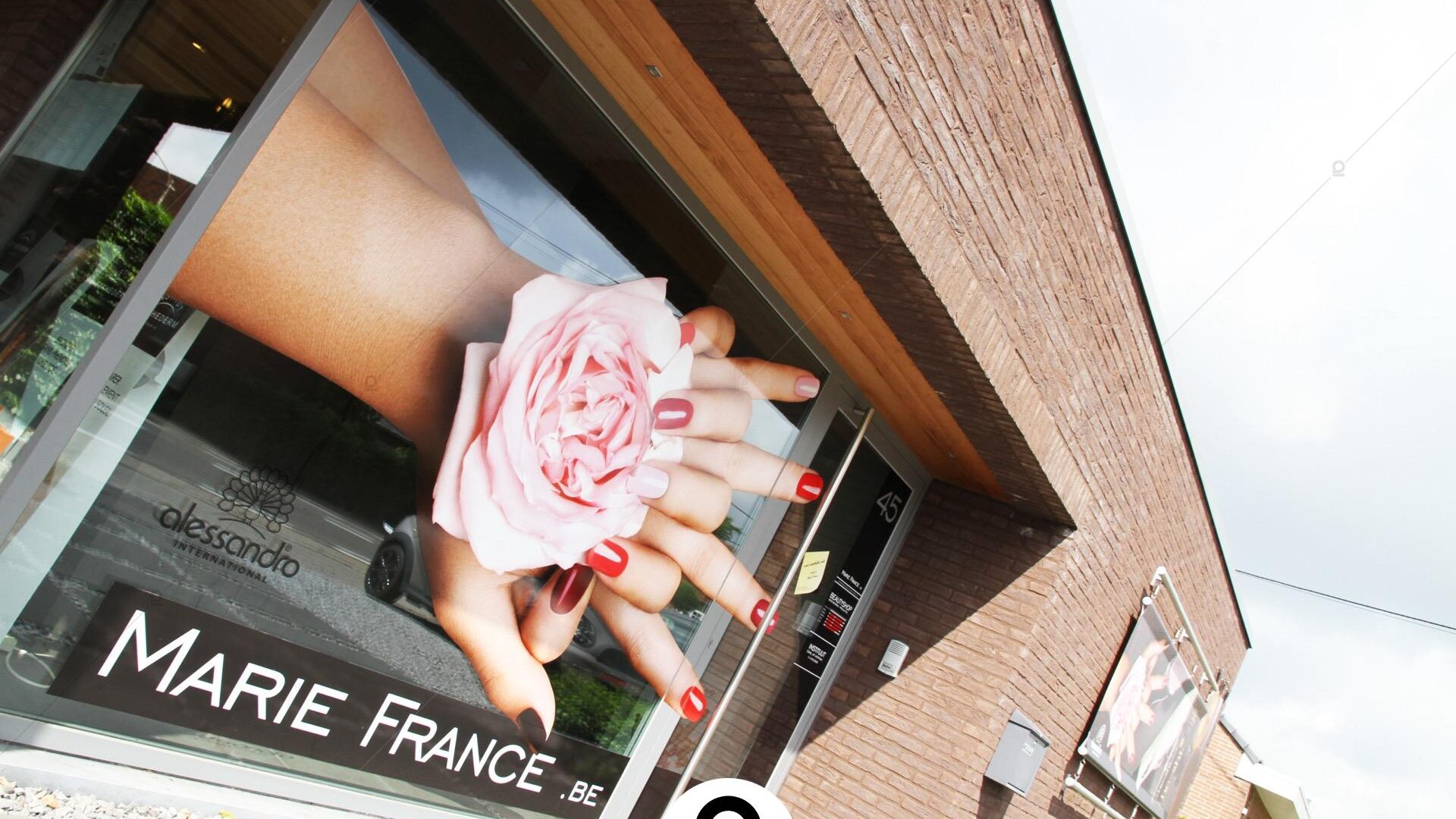
Window graphics are not one product. They are three materials doing three different jobs: printed vinyl, which blocks the view completely; perforated one way film, which lets people inside look out while a printed image reads from the street; and etched or frosted film, which gives privacy without taking the daylight. Most disappointment with window graphics comes from choosing the wrong one of those three, not from the artwork.
Glass is also the least forgiving surface we work on. It shows every speck of dust as a visible point, it is usually the first thing a passer-by looks at from two feet away, and it sits in a frame with a silicone bead that film will not stick to.
What Are Window Graphics Made Of?
Printed vinyl with a matching laminate is the workhorse: full color, opaque, and the right answer for a vacant unit, a seasonal campaign or a logo on a glass door. Perforated film is the same printed surface with a pattern of small holes, typically around half the surface open, so daylight and sightlines pass through from the darker side. Etched film is not printed at all; it is a translucent film that imitates sandblasted glass and is usually cut rather than printed, for conference rooms, clinic windows and the lower band of a shopfront.
For Malibu Brewing Company at Universal CityWalk Hollywood we printed a coming soon treatment across the whole frontage, some panels floor to ceiling and others in grid formations, and the film was chosen for clean removal rather than for longevity, because the graphics only had to live until the doors opened. That is a specification decision, and it saves the client money twice: once on the material and once on the removal.

How Much Do Window Graphics Cost?
As orientation ranges, not a price list: printed vinyl installed runs roughly 12 to 25 US dollars per square foot, perforated film a little above that because of the material, and cut etched film is usually quoted per panel rather than per foot. Access is the variable nobody budgets for. A shopfront at street level is straightforward. The same area three floors up, or behind a display that has to be emptied first, changes the number more than the film ever will.
Can You Still See Out?
Through perforated film, in daylight, yes, and it surprises people how well. After dark the effect reverses: once the interior lights are brighter than the street, the image stops reading from outside and the holes become visible from inside. For a restaurant or a bar that trades mostly at night, that matters, and it is the reason we ask what the opening hours are before recommending it. Etched film behaves the same at all hours, which is often why it wins for an office.
Where Do Window Graphics Fail First?
At the edges. The silicone bead where glass meets frame is not a bonding surface, so film is held back a few millimeters from it rather than pushed into it; graphics taken right to the frame lift there within months. Second comes heat: a south facing pane behind a dark printed graphic gets considerably hotter than clear glass, and on older or already stressed glass that thermal load is a real consideration rather than a theoretical one. Third is cleaning. A squeegee across a printed edge will find it eventually.
Large format on a facade is a different discipline again. For Carta Mundi in Turnhout we built a non permanent building wrap for their fiftieth anniversary, combining printed panels with Avery SW900 in gloss red, and for Jaga in Diepenbeek the whole brief was legibility from the highway. Those projects live under building wraps rather than under glass work, and the two get specified differently.
Frequently Asked Questions
Can window graphics be removed?
Yes, and on glass it is far easier than on paint. Removable film comes off cleanly with heat and patience; permanent adhesive leaves residue that needs a solvent and a plastic blade. The time to decide which you want is before printing, not three years later.
Do window graphics go on the inside or the outside?
Outside when the image has to read in full color and survive contact. Inside when the glass is exposed to weather or vandalism and the artwork can be reversed, which is standard for office glazing and common for etched film. Inside also keeps the film out of the rain, which extends its life.
How long do window graphics last?
Three to five years outside with a good laminate, longer behind glass on an interior application, and a few months for a temporary campaign film that was chosen to come off easily. Sun exposure decides more than anything else.
Will perforated film work on a shop that opens at night?
Not well. Once the lights inside beat the light outside, the printed image goes dim from the street. For evening trade we usually suggest a band of printed or etched film at a height that works with the interior lighting instead.
Do I need permission for storefront window graphics?
Often. Shopping centers, landlords and many municipalities set limits on how much of a window may be covered and sometimes on content. We ask for the lease clause or the local rule at the quote stage, because it changes the layout, and it is far cheaper to find out then. For reference on specification, 3M publishes its own windows and glass guidance.
If you are looking at a shopfront, an office glass wall or a full facade, we design, print and install in house at both studios. See the full range of architectural services, or send us photographs of the glass and the measurements and we will come back with a specification. There is also a companion piece on choosing a commercial window wrap and one on wall wraps for the surfaces either side of the glass.
