








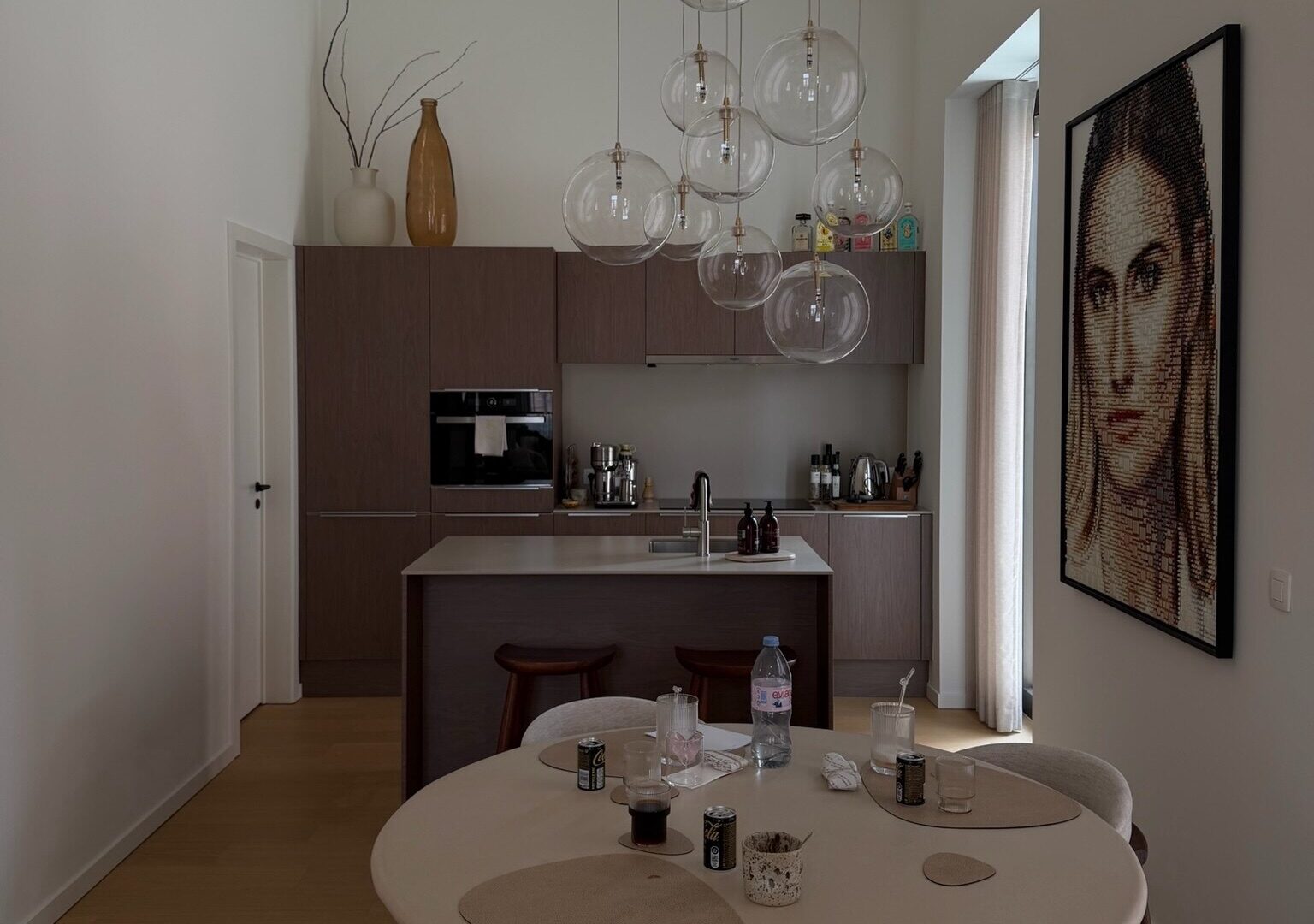
A kitchen cabinet wrap refinishes the kitchen you already own: the existing doors, drawer fronts and end panels are cleaned, repaired and covered in architectural film, so nothing is torn out. For an average kitchen in the United States, the work sits roughly between 1,800 and 6,000 dollars, against something like 7,000 to 12,000 for refacing and considerably more for new cabinetry. Most kitchens go back into use the same evening.
Those are orientation ranges, not a price list. What follows is what actually moves them, and what the film does over the years that follow.
What Does a Kitchen Cabinet Wrap Cost?
Shops quote per door and per linear foot of panel, not per kitchen, because a kitchen with eighteen flat slab doors is a different job from one with twenty-six profiled doors, glazing bars and a curved island. Three things move the number more than the film does: the number of separate pieces, the amount of profile and radius the film has to follow, and the condition of what is underneath. Handles, hinges and soft-close mechanisms that need removing and refitting add hours. Countertops and a backsplash in the same film are priced separately, and they are where many kitchens gain the most, since a worn worktop undoes a set of perfect doors.
Compared with a new kitchen, the saving is not only money. There is no demolition, no skip in the driveway and no three weeks of cooking in the garage, which is why this work suits apartment buildings and rental properties where a renovation is barely possible at all.
Is It Better to Wrap or Paint Kitchen Cupboards?
Paint is sprayed onto the door. Film is a finished, calibrated surface that is laid over it. On a lacquered or melamine door, paint needs flawless adhesion to a surface designed not to accept anything, which is why hand-painted kitchens so often chip at the edges where fingers land. Cast and calendered interior films are roughly 0.2 mm thick, non-porous, and they hold a consistent wood grain or stone pattern across every door in the room. A painted kitchen can be touched up; a wrapped kitchen cannot, but it is far less likely to need it.
Film also gives you finishes paint cannot reach. Oak, walnut and smoked timber structures, concrete, marble, brushed metal, leather grain: around 900 designs across the ranges we work with, including 3M DI-NOC and Bodaq.
How Long Does a Kitchen Cabinet Wrap Last?
Indoors, the film itself is stable for many years; what fails first is always an edge in a wet or hot spot. The door beside the sink, the drawer front under the kettle and the panel next to an unventilated hob take the punishment, so those are the panels worth inspecting after a few years rather than the whole kitchen. Steam that is allowed to roll straight up a door edge is the single biggest enemy, which is one reason we insist on a working extractor in the specification conversation.
Where a panel does lift, it is replaced individually. That is the quiet advantage of this method: the repair is one door, not one kitchen. Our own installation and color warranty runs for a year alongside the film manufacturer’s material warranty, and in practice adhesion shows its hand early. A wrap that has not moved in two months does not usually start moving later.
Why Preparation Decides the Result
Everything that will be visible in five years happens before the first panel is covered. Doors come off and are wrapped flat. Kitchen grease is removed with solvent rather than detergent, because film does not stick to a film of cooking oil. Dents, screw holes and water-swollen chipboard are filled and sanded level, because film follows every imperfection faithfully and flatters none of them. Edges are wrapped around the back of the door, not trimmed flush at the front, so there is no visible seam for a fingernail to find.
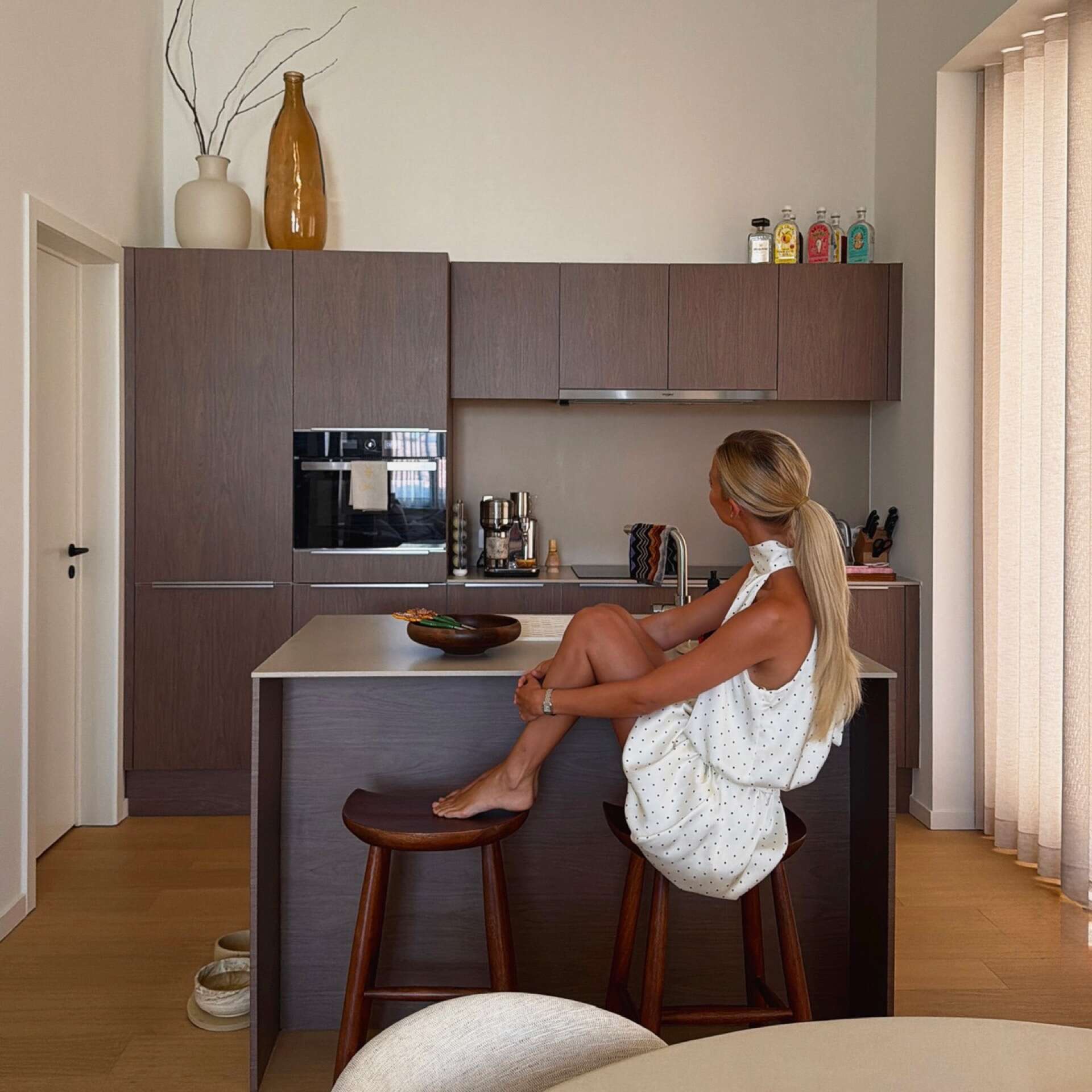
Two Kitchens, Two Continents
In a Wilshire Boulevard high-rise in Los Angeles, a client wanted warm timber instead of white lacquer in an apartment where a renovation was effectively impossible. Several panels had water staining under the sink; those were repaired first, then every door and surface was wrapped in a light oak finish by our Westlake Village team. This is the wood-finish kitchen wrap in Los Angeles in our portfolio.
In Herentals, Belgium, Celine Van Ouytsel’s white kitchen was finished in a wood-structure film, Original Oak AA14, by the team working out of Weelde and Turnhout. Same method, same preparation, a different room and a different climate. Our full kitchen cabinet wrapping service covers doors, countertops and backsplashes, and the same films are used for furniture wrapping elsewhere in the house.
Frequently Asked Questions
Can you wrap kitchen cabinets that are already damaged?
Usually yes. Dents, old screw holes and minor water swelling are repaired and sanded flat before wrapping, and that repair work is part of the quote. A door that has delaminated or crumbled at the bottom edge is replaced instead; film needs a solid substrate, not a soft one.
How long does the installation take?
Most kitchens are a one-day job, two for a large kitchen with an island and countertops. The doors come off in the morning and go back on the same day, and the kitchen is usable again immediately.
Is a kitchen cabinet wrap removable?
Yes. The film peels off and leaves the original door underneath, which is exactly why this works in rented and leased properties. Removal is a service we carry out ourselves, and it is quicker than the installation.
Can countertops and a backsplash be wrapped too?
Yes, and we usually recommend it. New doors against a dated worktop rarely look finished. Countertops take an abrasion-resistant film grade rather than the standard one, so they are priced separately.
Does the film peel near the sink or the hob?
Not when the edges are wrapped properly and the room is ventilated. Where it does happen, the cause is almost always steam hitting an unsealed edge, and the fix is a single panel rather than the room.
If you are weighing a wrap against a new kitchen, send us photographs of the doors and the worktop and we will tell you honestly which of the two your kitchen deserves. You can request a quote for architectural wrapping here.