








The van wrap ideas that survive contact with a real van all start in the same place: the panels. A van flank is a long, almost flat plane interrupted by a sliding door rail, a step, rivets and a fuel filler, and the rear doors are the only part of the vehicle most people will ever read properly. Design for those facts first and the artwork takes care of itself.
Most of what gets pitched as van wrap ideas is car design stretched sideways. On a car it works, because a car flank is short and curved and the eye takes it in at once. On a van the same layout gets sliced by the door rail and read from the wrong distance.
What Makes a Van Different From a Car?
Four things, and they decide everything else. The sliding door rail runs horizontally through the middle of the flank and interrupts any image crossing it. The flank itself is big enough that an eye at traffic speed never sees all of it. The rear doors sit at exactly the height of the windscreen behind you, which is where the reading really happens. And a van is usually taller than its driver expects, so the top band is above most sightlines on a busy street.
Panel sizes and what each coverage level costs are a separate conversation; we set those out in our article on what a van wrap costs, panel by panel.
Which Panels Actually Get Read?
The rear doors do most of the work. In traffic, a driver spends minutes behind your van and seconds beside it. That is the one place a phone number, a web address or a single line of offer earns its space.
The flank earns its keep when the van is parked, which for a service business is most of the working day, outside a customer’s house in the neighbourhood where you want the next job. Keep it to the name, the trade and one shape that is recognisable from across the road. The front is nearly worthless: almost nobody reads the nose of a van, and what is there is usually a grille.
Seven Van Wrap Ideas That Hold Up
One block of color, one mark. A full color change with the logo placed once on each flank and once on the rear. Artem Van Roey took a whole fleet in Belgium from green to 3M 2080 Gloss Hot Rod Red on this principle, and from fifty metres you read the company before you read anything else.
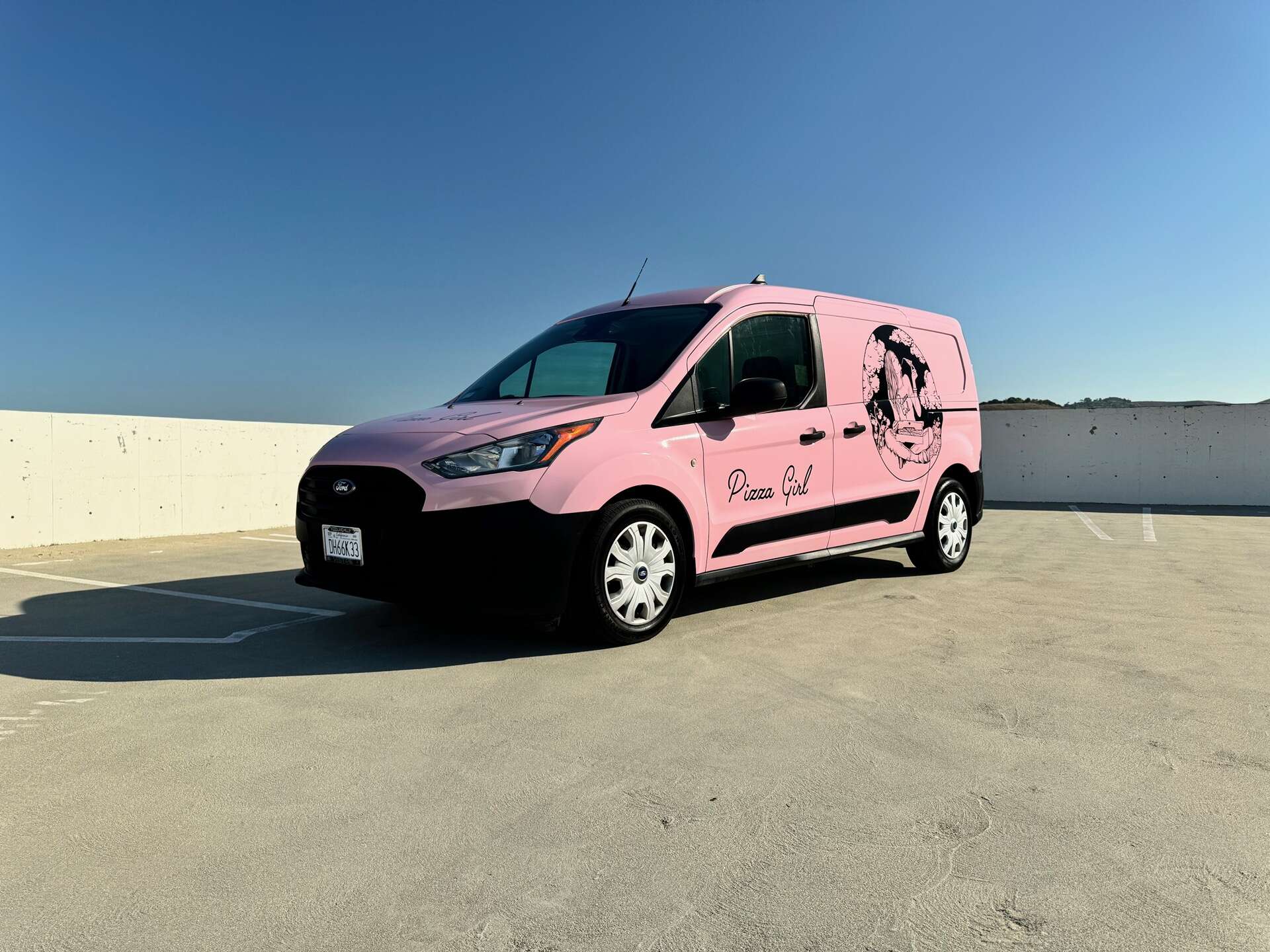
Full printed personality. Where the brand is the product, print the whole van. Pizza Girl in Venice Beach went out in a custom printed pink that is unmissable on the boardwalk, with the advertising message built around it rather than pasted on top.
A two-tone split along the body line. Two films meeting on an existing crease hides the sliding door rail problem instead of fighting it. The PopRak Sprinter runs 3M 2080 Gloss Dragon Fire Red against S120 Satin White Aluminum, templated on all four sides before a single piece was cut.
The rear doors as their own poster. Treat them as an A1 sheet, not as the back end of the flank artwork. One message, type large enough to read from two car lengths.
Partial coverage on a factory color. On a white or black van, printed panels on the lower flank and the rear with the roof and upper band left bare reads as deliberate and costs roughly half. More on where that line sits in our guide to a partial vehicle wrap.
Product photography kept above the rail. If the artwork has to carry an image of the thing you sell, put it in the clean band between the rail and the roof line, where nothing cuts it.
One template, every van. For a fleet, the idea is consistency, not variety. On the Intuit TurboTax rollout we wrapped twenty vehicles in four days on site in Los Angeles as part of an eighty-vehicle national program, and the whole value of it was that the twentieth looked exactly like the first.
What Should You Leave Off?
A phone number in small type along the middle of the flank. It reads perfectly in the design file and not at all at road speed. Fine print of any kind belongs on the rear doors or nowhere.
Artwork that crosses the sliding door rail with a face, a word or a hard edge in it. The rail will cut it, the door will sit a millimetre proud, and that is the detail everyone will notice. Logos across door shuts and handles have the same problem, and a seam over a handle is also where a wrap starts to lift.
Dark colors on a van that lives in California sun are a maintenance decision rather than a design one, and matte finishes multiply the washing problem on a vehicle that gets washed in a hurry.
Frequently Asked Questions
How much does a van wrap cost?
In the US market a full printed wrap on a mid-size van sits roughly between 3,500 and 6,000 dollars, with a large high-roof Sprinter above that and a partial wrap at around half. Orientation ranges, not a price list.
Do van wrap ideas need to match the rest of the fleet?
If there is more than one vehicle, yes. The value of a fleet wrap is repetition: the same shape seen four times in a week registers in a way that four clever designs never will.
Can you wrap the rear windows of a van?
Yes, with perforated film, and on a panel van with blank rear doors the question does not arise at all. What is allowed on a rear window differs by state and by country, and we check before quoting.
How long does a van wrap last?
Five to seven years on cast film kept out of constant direct sun, less for a van parked outside all day in Los Angeles, and less again for printed graphics without a good laminate. Rear doors and the lower flank wear first, because that is where the washing and the loading happen.
Will a wrap damage the van if it is a lease vehicle?
On sound factory paint, a professionally installed wrap comes off again and leaves the paint underneath. Older panels and resprayed panels are the ones to discuss beforehand.
If you have a van or a fleet and want a layout that works on the vehicle rather than on a screen, send us the vehicle and the brief. We design, print and install the whole thing ourselves. Film specifications for commercial vehicle graphics are published by the manufacturers, including 3M graphics and signage. For the trucks in the same yard, see our truck wrap ideas.
